

Showing posts with label Team 5. Show all posts
Showing posts with label Team 5. Show all posts
Saturday, July 30, 2011

Building the Buoy: DESIGN DEVELOPMENT
At our initial meetings we had dreamt up many ideas for what we could build from Doglands, an off the leash meet and great space for the dog owners of the city, to a pig farm that processed the sites waste then provided a nice spit roast lunch on the Saturday! I'm sure many would be relieved to know that these ideas quickly went out the window once we got our site and noted the reality of our context (for full site analysis and the concept behind Dirtybuoy please see our video).

The idea of needing both a more personable scaled space within the plaza and a series of buffer walls arose quite early in the first site discussion, purely on a consensus that without dealing with these two conditions, nothing would work on the site. The initial form of this wall was the idea of construction with milk crates. The concept of constructing from water was also a very early idea that was drawn from the site analysis, in particular the lack of connection with the water on a site that was all about the water. As the day developed we brain stormed over 6 different methods of achieving this outcome of compressed space and protective walls to ensure that we didn't put all our eggs in the one basket, especially in the tight timeframe.
 An early favourite emerged after an observation we had on our return from our first site visit. The interlocking modularity of the Fratelle water that the organisers had provided got us all into a flurry of excitement and we began taking over the water supply and playing around with the lego block like units.
 The system offered not only stability but an opportunity for storage in a simple system.
It even offered opportunity for integrating infrastructure.
 Pretty soon we realised that a whole single single wall would look best but may not offer the best stability! Until we realised that the modulation worked across the bottles too! We were getting way too excited over the Fratelle!
 After half a day of try to source the necessary 650 empty Fratelle bottles, we began to investigate other options of achieving the same outcome with an equally simple system. Jeremy's memory of the Hong Kong goldfish markets inspired the sandwich bag that we felt worked doubly as a scientific sample bag reference. On testing it revealed this amazing reflective capacity.
 We also had $500 of pantry out our disposal and after seeing the way that light was refracting through the sandwich bag alone, we immediately purchased the lights in the hope that it may provide an interesting night outcome.
 As the evening rolled on, we took a group bonding brainstorming session to the nearby COSTCO and nearly wet ourselves with excitement when we stumbled across these 170L tubs for $22! With a plan in sight and 6 ways of potentially achieving it, we signed off the design on Wednesday night and went to bed.
 Pretty soon we realised that a whole single single wall would look best but may not offer the best stability! Until we realised that the modulation worked across the bottles too! We were getting way too excited over the Fratelle!
 After half a day of try to source the necessary 650 empty Fratelle bottles, we began to investigate other options of achieving the same outcome with an equally simple system. Jeremy's memory of the Hong Kong goldfish markets inspired the sandwich bag that we felt worked doubly as a scientific sample bag reference. On testing it revealed this amazing reflective capacity.
 We also had $500 of pantry out our disposal and after seeing the way that light was refracting through the sandwich bag alone, we immediately purchased the lights in the hope that it may provide an interesting night outcome.
 As the evening rolled on, we took a group bonding brainstorming session to the nearby COSTCO and nearly wet ourselves with excitement when we stumbled across these 170L tubs for $22! With a plan in sight and 6 ways of potentially achieving it, we signed off the design on Wednesday night and went to bed.
 As it turned out on Thursday morning, 4 of the 6 options were not guaranteed to be done by our fireworks deadline of 5pm so we progressed straight to COSTCO and handed over $1300 for 42 tubs.
Building the Buoy: CONSTRUCTION
We started construction 9am thursday and wrapped up 5pm friday.

Our main 'construction' was the collection of water directly from the public marina in front of our site. We used a surveyors pole to measure the different depths taking samples from the surface through to 2m below.
 We then pumped directly into the structure via a lookout across the public thoroughfare to alert the public of the trip hazard. This time was also used to test the structural integrity of the main wall. In the above iteration the wall is a tight stretcher bond however the foot and lid system of the boxes meant that this arrangement could not lock into place and therefore could not withstand any horizontal pressure (much like a Jenga block configuration).
 At the same time we began to test the moveable wall, assessing the added windload of the bags and established that the best arrangement was alternating rows on the front and bag and staggering the distribution along the rows.

 As the construction starts to come together, unexpected effects appear.
 Here the two construction systems, side by side, show the rigid order necessary to maintain the structural integrity. As you can see, the solar lights are distributed throughout the stacker wall, all within the same sandwich bags as the moveable wall.
 We then pumped directly into the structure via a lookout across the public thoroughfare to alert the public of the trip hazard. This time was also used to test the structural integrity of the main wall. In the above iteration the wall is a tight stretcher bond however the foot and lid system of the boxes meant that this arrangement could not lock into place and therefore could not withstand any horizontal pressure (much like a Jenga block configuration).
 At the same time we began to test the moveable wall, assessing the added windload of the bags and established that the best arrangement was alternating rows on the front and bag and staggering the distribution along the rows.
1500 sandwich bags and 3000 mini pegs is a time consuming but safe and therapeutic construction method. Pretty sure there is not a single mini peg left in the greater Melbourne locale!
 As the construction starts to come together, unexpected effects appear.
 Here the two construction systems, side by side, show the rigid order necessary to maintain the structural integrity. As you can see, the solar lights are distributed throughout the stacker wall, all within the same sandwich bags as the moveable wall.
Building the Buoy: EXHIBITION


Throughout the day attracted many inquisitive passerby's from children to the elderly, locals and tourists. Most were fascinated to learn that the pollution was only evident in the top layers and were suggesting that if it is only so deep then perhaps it may be easy to return to its natural state.
More images of the exhibition are available here via Gus Kollar's flickr stream and will be added to the Urban Realities facebook page as the exhibition continues today.
Day 4: Liftoff
You will probably never read the following on any other blog in the city-we have just buzzed our way home after an amazing experience at Docklands!

After a busy day of bagging and hanging out the Yarra's dirty laundry, we opened up the site to the public at 5pm as the masses started drawing for the winter friday night fireworks display. After observing the movements around the site over the past two days (which generally consisted of people taking pictures of themselves, cutting through the site en route to another destination or just confused milling) we were ecstatic that our insertion created a new pattern, still a bit of milling but of a more inquisitive nature with many people touching the moveable/interactive wall or at the very least double takes from passing cyclists.
As the sun set, the last rays cut through the northern buffer wall, exposing the tier profile of the Yarra - the top 500mm of the water in the top box layer and grading down to 2m from the surface at the base of the wall. As the image illustrates, the suspected water infection is indeed skin deep, with a bacteria laden level at the surface and almost clear as it passes the two meter mark.
Once it became dark, the Dirtybuoy took on a life of its own with its watery volumes reflecting the harsh lights of the large TV screens and its regulated grid replicating the lights of the office towers in the backdrop. These two interactions were unexpected and of great joy, as was what was to follow.
As the crowds rolled in, we were inundated with curious punters, particularly children who squeezed, scrutinised and squealed with delight in examining the pockets of water on the moveable/interactive wall. Best of all, the previous occupation of the site- people taking pictures of themselves in front of the Melbourne CBD- shifted and now everyone was fighting each other to get pictures in front of the Dirtybuoy!
We were over the moon with these unexpected reactions and were all excitedly awaiting the arrival of the fireworks to test our observation window and see how the skin reflected the dynamic light display. Although this was one planned aspect, we were like kids in a candy store when this occurred....
It was during this display that we truly experienced that unique and overwhelmingly thrilling adrenalin that is only possible when a large group of people is gathered to watch something truly spectacular resulting in uncontrollable exclamation and excitement. Although many of us had seen fireworks before, the setting with the amplification of both the explosions across the hard surfaces of the dock apron and the light flickering across Dirtybuoy that was something that just can't be explained. It was one of those moments that can't be recreated on the screen, you just had to be there, which is what public space can and should be all about.
As you might have noticed, the blog has almost run like Memento, we have shown snippets of the final product and will now gradually reveal the plot or the developments that have lead to this point. As our small band of 6 has undertaken something that has required a constant hands on testing in order to be ready to experience this unique Docklands occurrence, we will now attempt to retell the story in reverse over the coming posts- stay tuned!
Friday, July 29, 2011
Thursday, July 28, 2011
Day 3: Update

pump + pick up the sandwich board + lift+ push + talk to a confused bystander + pick up the sandwich board + pull + watch tourist take photos of themselves in front of the giant tv screen + eat + scare off the seagulls + pour + stack + pick up the sandwich board + carry + clip + hold onto your hat = a sneak peek into the construction of site 9 still in progress
Wednesday, July 27, 2011
Day 3 Summary: Seeing the Sites

This morning the sun peeked through the clouds and the sites were revealed to the teams.
It was also the first time that the whole of team 5 were able to meet face to face and unfortunately lost 4 team members before the first siren. Enthusiastic for the task ahead, the group accepted the handicap and optimistically adopted the 'less is more' attitude.
Team 5 were second cab off the ranking drawing site 9 from the hat and, on inspection, decided to extend this mantra to our approach of revitalising Docklands. Site 9 is located on the northern edge of the docks in the centre of the forecourt for Waterfront City Gateway.

An early site analysis revealed...
-a large open, exposed space that lacks focus or interest
-an environment cluttered with public space cliches (stage + TV screen + statues + mural + temporary structure + mismatched public furniture + astroturf)
-it presents itself as a public destination but is used as a thoroughfare
-it features an 80's yacht nostalgia aesthetic (despite the lack of actual yachts)
-lots of sunlight for the northern promenade
-great views of the bolte bridge and CBD
-a lot of residential development within sight
-a lot of weekend activity
The site came with it's own brief 'Urban/Duced' which is explained as the following:
Provoking and inducing a reaction/evolution
Your site's illness remains undiagnosed. Through your site consultation, induce a reaction.
You are required to harness the existing site conditions to activate and heighten your outcome's performance.
You must consider the dynamics of time: eg night and day, site conditions, seasons etc
We are brimming with excitement for the project, stay tuned!
Day 2 Summary: Symposium
 Rather than create another lengthy text post I have instilled the summary of todays symposium as a mind map, which can be viewed in full here. Looking forward to getting our site tomorrow! Team 5
Monday, July 25, 2011
Day 1 Summary: Bitter Sweet
Urban realities launched today with a brief presentation at the stunning headquarters of VicUrban from a team of energetic, enthusiastic and engaged women from both the Melbourne City Council and Vic Urban. The presentation was a brief overview of the physical, social, economical and political history of the site from its early life as an aboriginal hunting ground, it's booming 50's, its bust 70's (and subsequent illegal rave life in the 80's) through to the most recent redevelopment and future ambitions.
The current ills of the site- it's lack of diversity in use, inconsistent urban materiality, impersonal scale and lack of public ownership- are due to the campus style subdivision and development of land that was necessary to ensure the investment injection. The next phase of development will focus on connecting the silos and in doing so ensuring that the wider community, that the development has the potential to attract, gets a say. This will be supported by the release of a Gehl architects public life report and recommendations later in the year and of course the short term stimulus of an event such as Urban Realities.
I think if there is anything that we have learnt from the VicUrban presentation it is the importance of collaboration in facilitating positive urban transformation. Collaboration enables the exchange and progression of ideas, enables an efficient use of resources, restricts personal agendas and ensures a more cohesive yet diverse outcome. The only way the site will be able to develop cohesively at all stages is through collaboration, including the development of ideas in Urban Realities.
Throughout the day we have all been exploring the site as individuals, in our teams and also just informally meeting and chatting with individuals from all teams. I hope that, even as the competition develops, we might be able to keep this exchange between the teams continuing for the benefit of whole precinct. I am not suggesting that we forego the competition but rather that we keep up an open exchange of ideas between the teams, and with the public, to ensure the diverse yet cohesive outcome that is needed to successfully realise the full potential of the site.
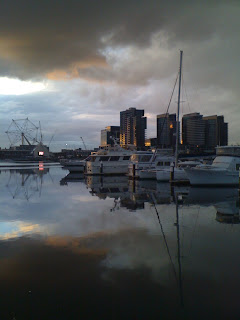
To kickstart this exchange I have included some images below taken this afternoon when myself and members from team 2 and 10 were exploring the site. During the VicUrban presentation it is noted that there is not an element of surprise at the site, but we were certainly surprised when the clouds parted revealing a setting sun and a stunning experience at the site. It would be great if our installations could in a way provide a new perspective of Docklands, one as surprising as this, which may be as simple as ensuring that people are at the site not just when they have to be there for work but also when it is at its best. Do yourself a favour and make sure you check out sunset at Docklands as it is far more stunning than my iPhone could ever capture!


Subscribe to:
Posts (Atom)